Notes: The Essex Bestiary has been compiled from a number of separate entries, entities, sources, and sorcerers. The originiating expert has been credited in brackets beneath the relavent beasts, although it is possible that that information is as, or possible more, unreliable than the detailed descriptions they provided.
Alan Headbold
Alan Headbold – or ‘The Alan’ as he is known in Suffolk – was a popular man in 19th century Chelmsford, having won the annual wife lifting competition four years in a row. He also achieved fame for rescuing Patsy, the Mayor’s Labrador after she fell through the ice on the local skating pond one particularly harsh winter. Unfortunately, it was this last show of courage that was to be Headbold’s undoing as a man. Convinced that Patsy was the true love of his life, he drove himself to a foaming jealousy upon seeing the Mayor proudly parade his trusted companion about the town at weekends. Headbold’s twisted delusion transformed him from local hero to feared villain. Headbold left his wife and home and retreated to the Tiptree caves. For several months villagers there recounted that he had begun to show signs of feral activity, scampering on all fours through the streets at night and stealing old pieces of meat which he carried away in his mouth.
By some mysterious method, he soon gathered a pack of other hounds around him; strays mostly but also some who had been thrown into the river as puppies in a failed attempt to kill them, the memory of which had ignited their hatred of Man. To the shock and amazement of all concerned, on the 14th June 1893, Headbold, wild-haired and naked but for a small leather flap dangling over his shrivelled manhood, led this pack of slavering beasts on a raid of the Mayor of Chelmsford’s manor home. Shattering through the windows in a series of great leaps the pack entered the poor official’s home just as he and his guests were sitting down to a fine dinner. Headbold is alleged to have appeared down the chimney, caring not for the flaming coals in the hearth which terrifyingly set his body hair aflame. One guest recounted that Headbold had rolled over the carpet at an in-human speed and then somersaulted onto the dining table roaring as he did so. He made a direct line for the Mayor but was smashed from his path by the massive punch of a blunderbuss wielded by Sir Panton Grieg Hanvorhandles, the fearless, seven-foot big game hunter. The big man had just retired from a life spent quenching his thirst for blood in the darkest folds of Africa, and having never lost his habit of carrying the thunderous weapon about with him wherever he went he brought the thing to bear with a practised ease even while others around him still had their forks in their mouths. With their leader presumed dead and the prospect of a decent meal on the cards, the remaining canines seemingly lost their spirit for vengeance and went about wagging their tails, accepting a petting from the waiting staff whilst the guests waited for their carriages. Whilst a huge pool of blood was found under the table, Headbold’s body was never found.
Since the the time of these extraordinary events, the chimney down which Headbold appeared has been solidly bricked-up. There is a thriving business inviting visitors into the house now, which the family enhances with rumours of scratching and faint growling behind there late at night.
[from the diaries of Hugh Paterson, a doctor of some repute]
The Baboons Upon The Marsh
Of all the recurring stories of Essex, the most pervasive is that of the ape gone wild. In our journey through the history of Essex it crops up again and again with such frequency it is tempting to believe that it must be more than the terrified bellowing of generations of feckless mothers haunted by the shambling abortions they left in the woods.
Amongst all our research the “Baboons Upon The Marsh” appear to be the most credible. The Dengie in Essex was long the centre of England’s ape trade, the docks at Burnham bringing in more than 700,000 baboons between 1503 and 1651. It was said that at their height the meathouses on the riverfront could peel 600 apes in a day. Sadly, the factories were destroyed by Oliver Cromwell in a fit of anti-monarchist zeal towards the end of the civil war, and Burnham moved on to other pursuits. Yet the locals would not forget.
Over the next hundred years a number of reports of shambling creatures cavorting about in the mud of the nearby marshes can be found in the local newspaper reports and court records. Some speak of “abominable cries loike that of childe” echoing across the saltings, others of “man, but not man, drunken of gait, but permantlye, like a man, like a man, but not man, not man.” It is a familiar refrain.
Over time these reports coalesce into a general belief of baboons roaming out in the mudflats, living off oysters and dirt, dancing across the rivers at low tide towards the civilised parts of Essex to the south and the north. Rumours of women enjoying lewd liaisons with these creatures of the marsh are as yet just the speculations of the authors of this book, but it seems a reasonable conjecture. The ways of our people do not change much, it must be acknowledged.
As the centuries have passed the talk of these baboons has faded, but perhaps that is because civilised life has retreated from these lands, and our gaze is turned away to more appealing things. It is said we see what we want, and the inverse is most certainly true.
from The Book of Essex Monsters by Prof. Dreg Twedloxx & Assorted Authors (1947)
The Bellowing Son
One of the worst creatures that blight these lands, a bellowing son can afflict even the quietest of women. In the earliest stages of childhood, a bellowing child is often indistinguishable from his human peers, but as the creature ages, it begins to lose the ability to mimic human speech and emotion, resorting more and more to frightening and incoherent outbursts of sound that barely even register as words to the human ear.
In medieval times, bellowing was considered a mild form of possession, perhaps by a goat or other belligerent animal, as opposed to a demon in the more advanced cases. However, in recent times it has generally been accepted that it is likely to be caused by a combination of unsanitary conditions and an excess of immorality. It is for this reason that it appears to affect the people of Essex more than those in other less benighted areas of the countries.
from “Medical Afflictions of the Essex Peasantry” by Alice Hedgecock (1937)
The Beast of Beacon Hill
Doubtless the reader has heard of the Bodmin Moor Beast, and Norfolk’s ‘Black Shuck’, but Maldon’s Beacon Hill plays host to its own, peculiar specimen of crypto-zoological obscurity. ‘Dangly Ubb’, as the locals have christened it, is neither lupine nor feline, but is reportedly a giant, hairy, breastlike monstrosity that has often been seen flopping around the hilltop. Originally thought to be a joke amongst the local milkmen (it is said to be most active in the early hours of the morning), the legend was lent significantly more credence when in 1992, councillor Donald Spavins claimed to have seen it lactating atop a streetlamp. Spavins later saw that the streetlamp was replaced in accord with health and safety town ordinances.
[so sayeth R. Field, a man of knowledge and wisdom]
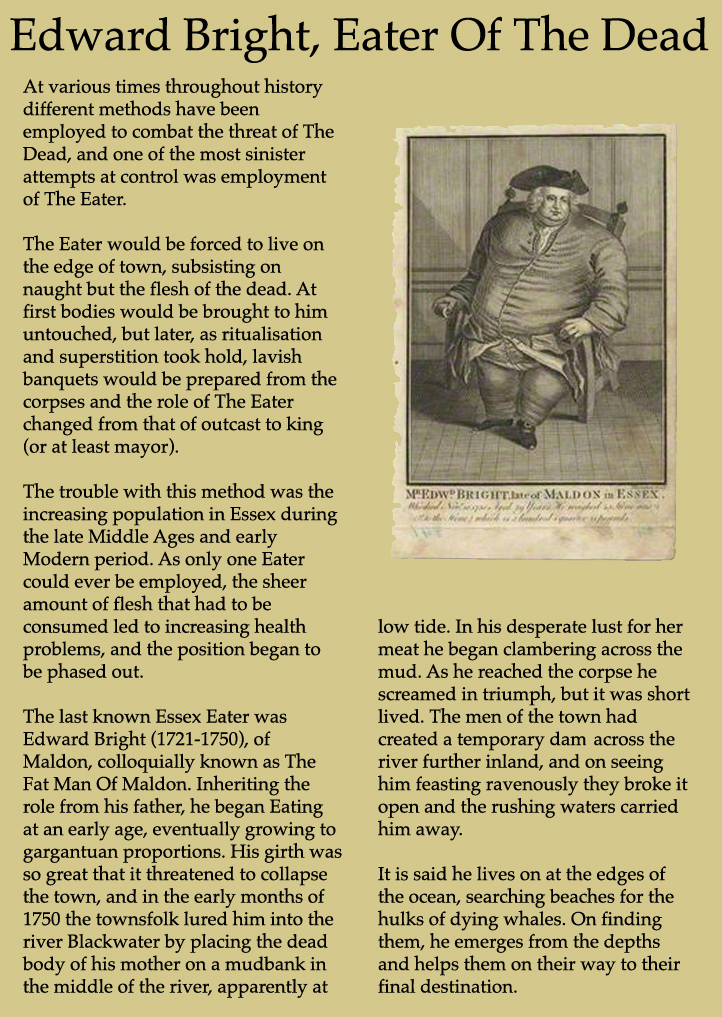
Edward Bright, Eater of The Dead
At various times throughout history different methods have been employed to combat the threat of The Dead, and one of the most sinister attempts at control was employment of The Eater.
The Eater would be forced to live on the edge of town, subsisting on naught but the flesh of the dead. At first bodies would be brought to him untouched, but later, as ritualisation and superstition took hold, lavish banquets would be prepared from the corpses and the role of The Eater changed from that of outcast to king (or at least mayor).
The trouble with this method was the increasing population in Essex during the late Middle Ages and early Modern period. As only one Eater could ever be employed, the sheer amount of flesh that had to be consumed led to increasing health problems, and the position began to be phased out.
The last known Essex Eater was Edward Bright (1721-1750), of Maldon, colloquially known as The Fat Man Of Maldon. Inheriting the role from his father, he began Eating at an early age, eventually growing to gargantuan proportions. His girth was so great that it threatened to collapse the town, and in the early months of 1750 the townsfolk lured him into the river Blackwater by placing the dead body of his mother on a mudbank in the middle of the river, apparently at low tide. In his desperate lust for her meat he began clambering across the mud. As he reached the corpse he screamed in triumph, but it was short lived. The men of the town had created a temporary dam across the river further inland, and on seeing The Eater feasting ravenously they broke it open and the rushing waters carried him away.
It is said he lives on at the edges of the ocean, searching beaches for the hulks of dying whales. On finding them, he emerges from the depths and helps them on their way to their final destination.
[account provided by David N. Guy (no relation)]
The Bobby
Feared by all, from the mouth of the river Blackwater to the anus of England known as the Thames Estuary, talk of the Bobby was always confined to whispered warnings even in the relative safety of a popular tavern. Known to prey on the weak and drunk, the Bobby terrorised the gentlefolk of Essex for over two decades in the mid eighteenth century ensuring its place in local legend. The beast was thought to have been roughly the size of a donkey but larger and ten times as dreadful. Always appearing at night, but never seen as a whole, the beast struck without warning at the unwary traveller, often knocking the hapless victim to the ground in a flurry of ungodly hair and loud snorting only to find that when they arose, bruised and bleeding, all their hay and apples had gone. Of note, from local records it is reported that in 1758 the Bishop of Maldon implored his congregation to stay in their homes between the hours of 6 in the evening and 7 the next day to avoid attack by the apparently ferocious Bobby creature. However it is later reported that the Bishop was taken into custody and then thrown into the sea without trial after it was discovered he had been committing lewd acts upon his own person in the village square late at night. Evidence of the Bobby becomes scarce after 1773 although brief mention is made in a parish magazine late that year of an inexplicably deformed skeleton of a man with four long limbs and an impossibly long head. It is rumoured that the locals found the unidentifiable remains scattered around four mysterious curved metal rods, presumably evidence of the monster’s diabolical strength.
from The Book of Essex Monsters by Prof. Dreg Twedloxx & Assorted Authors (1947)
The Brain Tree
The first appearance of the Brain Tree in Essex folk-lore is in the Cronicle of Chelmesford. Under the entry for 1352, following a brief description of the recurrence of bubonic plague in this year, a meat-fisted scribbler briefly displaces the usual neat monkish hand and scrawls “Bee ware ye BRANETRE”. Recent attempts to link this with the catastrophic outbreak of bran-induced flatulence that rendered Chelmsford uninhabitable for large periods in the late 14th century have been refuted, and Dr. Plectrode’s suggestion that this is a first-hand witness of the Brain Tree remains the most plausible.
According to legend, the Brain Tree is a large willow usually associated with the River Pant (previously Shitpant), although some stories also link it with the Blackwater. It lulls weary travellers to sleep in its shade, then wraps their heads in its long trailing branches, and eats their brains. The victims are then discovered by passers-by, incapable of rational thought or coherent speech, and are integrated seamlessly into Essex society. In the sixteenth century, belief in the Brain Tree was so strong that mobs swept the Essex countryside looking for willow trees to burn them down, with the result that Essex now has fewer oak trees than any other region of comparable size in England. The last recorded mention of the Brain Tree in Essex oral tradition comes from the Reminiscences of Derek Poke (1884), in which he mentions that a tree branch knocked his uncle’s brains out, but that his uncle survived to father four children and become a vicar after a pig’s brain proved to be an adequate substitute.
from The Book of Essex Monsters by Prof. Dreg Twedloxx & Assorted Authors (1947)
The Burning Of The Leaves
Every year at the start of September, gatherers sweep the towns of the Dengie, carefully picking a leaf from each and every tree in the parish. A bonfire is built from the leaves, and, on the evening of the 21st, lit. As the leaves burn summer drifts away with the smoke.
Once, a man refused to let the gatherers pick a leaf from his tree, for he had recently planted it over his wife’s grave and was concerned it might not make it through the winter. The tree survived, and that winter did not even shed its leaves, instead producing a constant abundance of fruit.
His neighbours refused its harvest, however, and the man had to eat it all himself. On the first day of spring a pip lodged in his throat and he choked to death and died. The leaves on the tree burst then into flames, and they never grew again.
From Customs And Sayings Of The Peoples Of The Coasts, by Simon Shirlthrell, published in 1963 by The Folklore Society.
The Butcher of Beeleigh Road
John Compton’s trade was no secret: he ran the local butcher’s shop on Maldon High Street from 1955 to 1978, and was known by all to be a large and ruddy-cheeked fellow who took great pride in his work, and always spoke the best of people. Yet what of the other John Compton? The one who hid away from prying eyes, long into the evening each night in his home on Beeleigh Road? Could he have been laughing maniacally to himself as he sharpened his butcher’s blades, eyeing the children of the local comprehensive and imagining their blood washing through the streets and into the gutters? Could he really? He had to be hiding something, did ‘Jolly’ John Compton.
[as told by R. Field, esq]
The Charming Skeleton
There lived upon the marsh a skeleton of unnatural charms, who, despite the lack of flesh or mud upon her bones, provided the most alluring sight many Essexmen had ever witnessed. It was said that just a single coquettish clack of her jaw could cause a man of married means to abandon his vows and leap through the windows of his connubial prison to chase after the illusory freedom of a night with this calciferous wench. Of course, the skeleton would lead the men not to liberation but to the eternal subjugation of death and devilment.
The nameless skeleton would take the men to a graveyard and entice them into a hole on the promise (never stated, for her fleshless face was incapable of speech) of a night of blissful coitus in her supposed bed. Upon realising that she would not join them, and that her bed was in fact a grave she had freshly dug, the men often became somewhat depressed and would refuse to leave, sighing away to an early death rather than return home, for that would entail an admission of their gullibility and of how easily they had succumbed to their lustful perversions.
It is not known where the adventures of this charming bonestress ended, but she was last seen on the roadways of Essex in 1449. Some say she fell in love with a beached whale and dragged the beasts bones back into the depths to prove her love, others still that she moved to Kent and stole a horse, but the truth shall likely never be known.
From Essex Bones: Tales Of The Skinless Days (1432-1456), edited and possibly fabricated by Webbingsley Munkton and first published in 1879
The Crabbus Man
‘As any fool know, to walk after dark through Promenade Park is to walk in the shadow of death; for there the Crabbus Man lurks and scuttles, with his clacking claws and twitching eye stalks, ready to leap upon the unwary and clack at them, they whose souls shall know no peace for all their remaining days upon the Earth…’ Or so wrote the Reverend Joseph Arkwright in his diary for the year 1863. Arkwright never saw the creature himself, though his borderline obsessive documentation of the Crabbus Man, including many incidents of its manifestations as sundry simulacra throughout Maldon (be it a cloud that ‘rather resembled a crab’s claw’ or a shadow upon a grass verge that ‘seemed to scuttle most unwholesomely’) has become the go-to source for Crabbus lore.
[for a full accounting of The Crabbus Man, please stand by]
The Dead
The dead have long been a source of irritation for the people of Essex. Somtimes seen shambling here and there on the edges of the towns, and often found clogging up brooks and rivers (the dead cannot swim), no matter how much they are ignored they never seem to fully go away.
12th Century Essex Chronicler and Monk, Ralph of Coggeshall, described the dead in his Chronicon Anglicanum as symptoms of nostalgia, considered one of the great sins of medieval times. Others, such as Witch murderer Matthew Hopkin, have subscribed their appearance to hallucinations brought on by the unique mixture of lust and rotting marshland that permeates the Essex countryside. Their true origin, however, is unlikely to ever be discovered.
“There are more of us than there are of you” is the dead’s one irrefutable cry, and no matter how desperately the people of the county have tried to breed their way to dominance, the living have yet to outnumber them.
The Essex Throttler
Years before London’s Jack the Ripper would stalk the streets of Whitechapel in search of victims, a far more vile and mysterious entity began a reign of terror throughout Essex that would last well into the next century. It became known simply as ‘The Essex Throttler’, for that is what it did: its prey were seldom granted the sweet release of death, as in Jack’s case; but instead were throttled to within an inch of their sanity and left as pallid, idiot revenants, white haired and wild eyed, to wander the streets of Essex townships, babbling incoherently about their experiences. It is said the rise of the British ‘Chav’ population has its genetic roots in these poor and damaged souls.
[from the lips of R. Field, whispering beneath the pier]
The Eternal Beating Heart At The Centre Of Existence
Although it has never been seen by human eyes, it is a matter of irrefutable fact that at the centre of existence there lies a huge and powerful heart, beating its way relentlessly through time, each beat separating out existence into a series of distinct moments so that we can live.
The best method for hearing the echoes of this huge celestial heart is to sit in your garden and night and push a cat as close to your ear as possible, holding it there despite its protestations, listening, listening, listening. The cat, unhearted and inert, acts as the perfect conduit for absorbing and amplifying sound, its whiskers perfect antennas that can pierce the walls between the worlds.
A dog will not suffice
This short and possibly unfinished article was found in the papers of Toby Vok that were bequeathed to the county of Essex upon his disappearance in 1990. As far as can be ascertained, it has never been previously published.
The Tale of Gin Susan
In the late 1700s, under cover of darkness, a publican’s daughter by the name of Susan Tines is said to have snuck out of the Swan and Bender Inn, Colchester, clutching tightly to her person a letter she had written only that evening. Her intent was to deliver it (the recipient unknown) before the nearby churchbells sounded in the new day; for if she did not, she would be condemned to die young and in agony. Where had she learned of this terrible fate? In another letter received that very day, demanding that if she was to live she must pass on its curse. It is quite possibly the earliest recorded example of the chain letter phenomenon, and an 1848 copy is on display at the Chelmsford Museum of Antiquities (attributed to Thomas Chatterton, given its pseudo-medieval stylings).
Sadly, so the story goes, fate was not on Susan’s side as barely a few yards from her home she ran into a friend of her father’s and was quickly apprehended, returned, and locked away in her room. The pressure of these events appears to have snapped Susan’s fragile, womanly mind, as on the following day she drank herself into a gin-induced stupor and fell down a drainage ditch; whereupon her still-warm body is supposed to have been devoured by blind, piglike creatures rumoured to live underneath Colchester.
That is not the end of the story, however. For it is said that if any who know this tale choose to propagate any sort of chain letter, Gin Susan’s bloodied, half-eaten specter will appear by their bed and drag them off to the Colchester tunnels.
The tale of the tale does not end there either. In the late 1960s, an Essex medium operating under the name of Madame Cravatsky (real name Enid May Beake) claimed to have contacted the spirit of Gin Susan, and offered to give a public demonstration of her talents to a small audience at the recently opened Civic Theatre. The ensuing spectacle involved much wailing and over-consumption of gin, after which Blavatsky manifested a pool of ectoplasm before passing out completely.
Whatever the truth behind Gin Susan’s tragic tale, this writer at least shall be held in check by it whenever a chain letter should happen to arrive in the post. Perhaps you will now, too.
[R. Field is now dead, unrelatedly]
Gordon Of Essex
Page seventeen thousand four hundred and eighty two of the Essex Chronicle of Idiots (Volume 5), tells of middle-aged man — the self-styled Gordon Hood, later ‘Gordon of Essex’ — who, inspired by tales of a contemporary Nottingham-based vigilante named ‘Robin Hood’, attempted to emulate that champion of the poor but failed entirely with disastrous results for the general population.
14th century records (mostly wanted posters and instructions to kill on sight, hand-written and circulated by the general public using whatever materials were to hand at the time) convey that through his misguided efforts Gordon Hood drove the local poor folk into a downward spiral of increasing poverty, homelessness, migration and suicide for almost a decade. The resultant mass exodus away from and mass loss of life in the county of Essex and across East Anglia has secured his place in local and regional lore ever since.
Gordon’s main problem was that he hated the poor. He had himself been born into a noble family with strong connections to the Crown and been raised among great wealth and privilege. Try as he might, he seemingly could never discard the ingrained notion that the poor deserved their suffering and indeed in many cases were not suffering enough. This notion had a habit of overwhelming him in the midst of a well-meaning action, reversing it, and is thus suspected to be indicative of a genuine psychosis.
For example, on 19th September 1382, Gordon carried out a daring hold-up on horseback of a wealthy merchant’s treasure carriage as it travelled through Epping Forest to a depositing bank in the City vaults of London. However, just as he pointed his drawn bow at the carriage driver, he underwent a schizophrenic change of heart. He immediately drove his horse in the direction of the nearest small village and raided it. The Sheriff of Essex’s records, taken from surviving witnesses, state that Gordon rode into the centre of the village, waving his sword and screaming “Damn the poor!” with such force that he spat blood. He proceeded to enter each hovel in turn, chasing the inhabitants out of their homes, stealing what precious little they had of value and throwing it into a large sack. Just before the Sheriff’s men arrived to stop him, he set the village alight with a number of well-placed flaming arrows and disappeared into the forest. Gordon must have ridden for over an hour before he caught-up with the merchant carriage he had interrupted earlier. He promptly delivered his bulging sack of trinkets to the occupant via the window. He then cantered away into the foliage and went into hiding again. This was but one of over seven hundred such incidents attributed to Gordon over a ten year period.
When his true identity was finally discovered, his family, driven by shame, gathered a small army and scoured the county in search of their errant son. After a few months of searching, they finally cornered him at a run-down Friary where he was terrorising a tiny child. He was found clutching at the scabrous orphan, emaciated and blind, yelling in its face that it must submit to a scalping so that the value of its hair might be better applied to the balding pate of the Earl of Essex. Despite being a physical wreck, the unfortunate child was putting-up an admirable defence, squirming and kicking at Gordon’s shins with what little strength it could muster. Gordon’s father and younger brother led the capture, trapping him in a net thrown from horseback, and so his reign of terror was finally ended. The eventual fate of Gordon of Essex is obscured by sheer weight of wildly varying personal accounts and rumour.
[from the diaries of Hugh Paterson, a know charlatan]
The Grey Men, and Women Also
The Grey Men, found throughout Essex, are mostly sufferers of an unnamed disease, recently found to be caused by a mildly mutated form of the bacteria Mycobacterium leprae, harbinger of Leprosy. The mutation of this bacteria causes irreparable rotting of the synapses in the brain, categorised most clearly by an increase in the amount of banal empty phrases and conversational gambits used by the sufferer. In extreme cases, the Grey Man (Or Grey Woman, although this is much rarer) ceases to be capable of any speech beyond talking about the weather. “Looks like rain” has became a phrase of utter terror throughout the county.
Transmitted by prolonged exposure to uninteresting ideas, groups of sufferers are often found together in huddles and queues, staring blankly ahead, a facsimile of discussion breaking out a mongst them that on closer inspection is little more than the repetition of stock phrases and stale opinions.
In modern times, Grey Men are most often found waiting at bus stops. Indistinguishable from unaffected people, it is only when they refuse to join you in getting on the bus do you realise how narrow your escape as been. You look back out the window and watch the rain begin to fall upon the unmoving line of them. The relief is so great you don’t even begin to feel resentful of the other passengers for a stop or two.
The Laughing
Once a man was driving through Essex late in the evening when he saw two children sitting next to each other. He shouted “What are you looking at you cunts” at them. But the two began laughing loudly. The man drove on and after a while he encountered the same two children, who began laughing once again.
The Maldon Mer-Man
In the spring of 1780, local eccentric and prestidigitator, Alan Mulvane, claimed to have caught a bizarre sea creature whilst out fishing on the Essex salt flats, ‘Thee lykes of wiche fulle horribele it wass and no mistayke’. It was immediately put on show in what was to become one of England’s most famous freak shows, drawing crowds of up to twenty people at a time. Some claimed it was just an old boot that Mulvane had stuffed full of sandwiches, but still others noted an uncanny resemblance betwixt it and the sea trout of the nearby tidal estuary…
[account provided by R. Field, who was rumoured to come from the north]
The Midsummer Maze At Maldon Marsh
The Midsummer Maze was an event held annually in Maldon from antiquity up until the modern day.
The Maze was a network of trenches, said to have been at least six feet deep, dug into the muds of the marsh. Each Midsummer’s Eve, at the lowering of the tide, townsfolk who were in need of the charity of their betters or the favourings of their gods would enter the Maze by the Eastern Passway. There they would try and find their way through the disconcerting network of passages without getting lost, becoming stuck, or being overcome by marsh madness (a debilitating affliction with symptoms similar to post traumatic stress syndrome).
Those that managed to emerge successfully from the Western Opening before sundown (the entrances and exits were aligned symbolically with the positions of the rising and setting sun) received the promise of good luck and a showering of silver coins from the Mayor and his wives.
Those that did not manage to emerge were lost to the marsh, drowned by the rising tides and sucked slowly underground during the night. Any participants that emerged, confused and ashamed, from the Eastern Passway were driven from the town and never mentioned again.
In 1915 the local council entered into a contract with the British Army for the procurement of mud, with which a series of full scale replicas of the then current positions in France were to be built, precipitating extensive mining of the marsh that continues to this day. Although the Midsummer spectacle of the Maze was ended by these developments, echoes of the event still persist in both the Maldon Mud Race (held traditionally at Midwinter) and The Drownings (August 17th, weather permitting).
The Morning Birds Free The Souls, The Night Ones Take Them
“In Essex, for example, it was a commonly held belief that heaven resided in the earth and hell within the air. Crops grew from the ground, while fire and smoke rose upwards.
“Worms were believed to be new souls struggling to the surface from heaven, and only with the help of the morning birds could they be pulled free and delivered to the newborns that needed them. A child born in the morning was said to be blessed with a good soul.
“Upon death, the body was returned to the ground, so as to be nearer heaven. The bodies of the sinful and the condemned were hoisted up and left on the roofs of houses, so that the evening birds (crows, gulls, owls) could pick clean their bones and take their flesh up into the skies towards damnation.”
Taken from “The Other English Traditions”, by Margaret Baker, published by David And Charles Country Books, in 1971.
Old Crow Head
Old Crow Head popped out of the woods and into town,
And squawked and flapped and pranced around,
But no-one paid her too much mind,
Just thought she was an abomination of her kind.
She came upon a bishop at work,
His rod pushed up a young woman’s skirt.
Old Crow Head with her beak attacked his neck,
And the bishop was dead before he could say “Oh heck!”
“Old Crow Head you saved me from a life of strife.
“Let’s get married, as wife and wife.”
Old Crow Head didn’t know what at all to say,
So she bit the girl and flew away.
The townsfolk found the maiden, all covered in blood,
Beside her the bishop, still dead in the mud.
“For this crime young lady you must pay.”
And built there a pyre out of bales of hay.
The burning hour was soon at hand,
As the sun set across the land.
They faced the girl out to sea,
And let her weep and cry and grieve.
The flames licked up around her feet.
She thought, “All this because of the Bishop’s meat.
“I can’t believe I’m going to die,
“Underneath this impossible moonless sky.”
“My only crime was to be a girl.
“If it wasn’t the bishop it’d’ve been the earl.
“This county’s men are all the same.
“When you have power you don’t need shame.”
The flames of the fire rose higher and higher,
And the crowd behind shouted, “Liar! Liar!
“You filthy cow! You wretched whore!
“I hope in hell they hurt you more.”
And just when they thought her death was assured,
Above them the flapping of wings could be heard.
Like a heart they beat, astonishing loud,
They blew out the fire and dispersed the crowd.
Old Crow Head flew down and chased them all around,
Across the beach into the sea, where thousands were drowned.
The rest of them? I suppose they got away,
But where they went only God herself could say.
And then by her love Old Crow Head did land,
And placed a wing in the other’s trembling hand.
“Caw caw caw,” said Old Crow Head,
And together they lived until both were dead.
from “The Songs Of The Slums”, published in 1903 by Prittlewell and Pitsea Press, and edited by Mary Savage
Peter Pitt and Mary Mye
The Essex Bestiary, Ted Vaaak’s three volume masterwork (The Time Before Memory And Recollection: 3000BC to 1977, An Abominable Year: 1978, and An Ever Increasing Density Of Disgust: 1979 to 1990) that was published to great acclaim in 1991, catalogued in great detail every fearsome beast, every genetic mutation, every ghost and every goat that had ever terrorised the folk of this county. And yet none of these creatures contained within it were as monstrous as Peter Pitt and Mary Mye, a pair of Essex itinerants of such abominableness they transcended the restrictions of their human births and became beasts of almost mythical stature.
Little is known of their origin, and even less of their ultimate destination, but of their journeys none in Essex are ignorant. At every bus-stop, at every train station, in every park and every High Street, somehow always they would be there. And, always, arguing. Peter Pitt, his face red as burning coal. Mary Mye, her whole body twisted in a lemonchewing scowl. Obscenities flung back and forth between their lips with such power and metronomic regularity they could have been used to power an electric dynamo if only the council had heeded my plans. Always in progress when you arrived, and undimmed in ferocity when finally you escaped, the underlying cause of their disagreement has always been impossible to discern.
For the last fifty years the people of Essex have had no peace. Silence is unknown until death. We wait, we dream. Around us the battle rages.
The Story Of A Grave
The tombstone of Barry John Johnson looks no different from any of the others in the quiet cemetery. It’s a plain stone slab, decorated with a simple cross. It lists Johnson’s date of birth (2 December, 1613) and death (3 January, 1647), states his rank (Sergeant), and mentions his service against the Roundheads at the battle of Marston Moor.
If you were to dig beneath the stone, however—an act which is forbidden by a special order from the office of the Witchfinder General—you would find something out of the ordinary. You would have to dig through three feet of earth, then three feet of slightly different earth, then scrape through a thin layer of gravel, scoop out a hundredweight of treacle, extract several cubic metres of compacted white dog shit, go through a scale model of the Great Pyramid with a pickaxe, then break open a metal enclosure that reaches ten feet into the ground, and then dynamite your way through a solid marble sarcophagus before you got to the metal casket, which is lined with lead sheeting. If you finally managed to get the casket open, you would find what appeared to be a mummy or possibly a frankenstein, wrapped in successive layers of lead, corduroy, tweed, silk, sackcloth and ashes. After unwinding these wrappings, you would finally see the mortal remains of Barry Johnson himself. You would notice that his belly and chest have been roughly sliced open and his internal organs removed, along with his feet and most of his teeth. While pondering this macabre scene, you would be absorbing enough evil to put your immortal soul in peril. For Barry Johnson is better known to the world as Jack Pudding, the notorious Dancing Man of Walthamstow.
[from the teachings of Matthew Bladen, a scientist]
The Testimony Of Alan Sturgeon
“I returned from the war to discover that my brother [Barrence Sturgeon, a man of both physical and mental inefficiencies] had been taken into the employ of Alexandra Spindleshanks [a local businesswoman and Quaker]. How he came by this job I do not know for no-one liked to speak of him. I supposed eventually that with the rest of the men of the village away in France there would not have been much choice. But still it was a surprise.
“He was devoted to her, though. My mother said that he barely returned home such were the hours he worked, and when he did he was withdrawn and sombre instead of his usual loud and unbearable self.
“I thought very little of it all, in all honesty, until one day when I happened to be walking through the woods by her house. Through the trees I could see my brother walking, back bent so low his face was almost to the ground, following what appeared to be a small dark dog. He continued like this all the way to the front door of the house, where he straightened up slightly to open the door, before resuming his earlier position and scuttling inside behind the creature he was seemingly acting as a personal valet for.
“This abject display of humiliating servility – to a dog! – roused a fury in me which I could not contain, and I rushed after him, barging open the door into the huge hall of the house.
“At the far end of the chamber, in an armchair by the foot of the stairs sat Alexandra Spindleshanks. She stared straight ahead but her limp posture and the slowness of her breath gave the impression that she was asleep. She was bound in a cloak, which by concealment made her look so small and frail I wondered briefly if she could even have any arms.
“Before I even really had time to finish that though my attention was drawn again to Barrence, who continued to make his bowed way across the room. I could see now that it was not a dog that he followed, but some spiderish thing of unknown design. It could possibly even have been a crab. It clattered its heavy legs down onto the tiled floor and the sound of them was like hammers striking metal spikes into the ground.
“Whatever it was, it was making its way towards Mrs Spindleshanks, and without thinking I withdrew my service firearm I fired two shots at the creature. The first bullet hit the creature square in the back, which caused it to exploded with unexpected force, covering the floor in a surprising amount of flesh and bone. The second bullet smashed a vase on a nearby sideboard, but I do not know how.
“Barrence fell then to the floor, wailing and weeping in grief. He gathered up the remains of the beast and cradled them in his arms. I asked him what he was doing and he said “It is important to serve your masters, even in death.” He climbed the stairs and entered a room somewhere up there and would not come down.
“Mrs Spindleshanks turned her head slightly at the slamming of the door upstairs. I could not tell if she saw me, however, and presently I left. I did not see my brother again until this today.”
From the trial of Barrence Sturgeon, who was eventually convicted and hanged for the brutalisation, dismemberment and murder of Alexandra Spindleshanks in 1919.
The Witch
Many times have I asked myself why does the witch seem to be more prevalent in Essex than it does in the further lands. Walking down every road I see swarms of them, cackling, groping, eating, displays of such grotesquery I find it unbelievable that there is not more screaming within these towns. Not even our pubs are safe anymore, where witches can often be found behind the bar, their vile hands touching the very glasses that we are expected to drink from.
Much talk has been made of the fact that if you draw a pentagram across the map of our isles one point will be poking its way into the Essex heartlands, but I believe this to be unlikely. The Essex Witches, having survived purges and burnings, remain undiminished, and one has to ask the question: “Why?”.
I believe the answer lies in the breeding marshes of the Dengie. This rich fertile mud, corrupted by the salt and the filth from the bloodsoaked waters of the Blackwater. Fed by the immortalised Saxon carcasses of the Battle of Maldon, their flesh degrading eternally yet always replenished, these perverted fields, which once gave birth to barley, now abort their twisted daughters out into the world, there to shamble into our towns, our houses, and even our sheds.
This is an excerpt from the controversial 1953 essay “Witch Heaven: Maldon, Mundon, and The Breeding Mudmarsh Between” by Peter Hedgecock, a noted local historian, farmer. Unmarried, he was most famous for his help in the revival of stocks of the Essex Pig.
Appendix I: Methods Of Divination In The Essex Prophetical Arts (And Associated Misbehaviours)
The people of Essex, like all the superstitious tribes, have a long and varied history of oracles, see-ers, and other prophetic charlatans. Among the more commonplace methods of divination, such as astrology and torture, there are many more that are unique to the county. In her groundbreaking study, The Dictionary Of The Essex Prophetical Arts And Misbehaviours (1973), Freyja Peters PhD, a local Witch and expert Nettlomancer, catalogued these bizarre ways – many of which are still in use today, over 40 years since the manuscript’s original publication.
The arts mentioned below were practiced, and in some cases are still practiced, within in the county borders but not, as far as is known, beyond.
Bellomancy – The art and practice of divination by shouting, especially the shouting of words of rudeness.
Clappomancy – The art and practice of divination by the enthusiasm or otherwise of the clapping of children held in captivity.
Clodomancy – The art and practice of divination by mud, including the eating of mud.
Eroticusomancy – The art and practice of divination by the observation of the behaviour, actions and pendulations of slatterns.
Extechnologiculumospicy – The art and practice of divination by the usage of obsolete forms of technology, such as non-automated looms or donkey-drawn barges.
Lobstromancy – The art and practice of divination by the seduction of lobsters or other equally pugnacious crustaceans.
Nettlomancy – The art and practice of divination by pushing a child into a patch of stinging nettles and interpreting the fury of the resulting cries. This method was outlawed by the constabulary of Colchester due to its surprising and often disquieting accuracy, and therefater replaced by less accurate and more humane methods such as Clodomancy and Eroticusomancy.
Transuromancy – The art and practice of divination by the use of the forbidden elements.
Trousomancy – The art and practice of divination by the observance of the flapping of clothes on a washing line, particularly a rotary washing line.
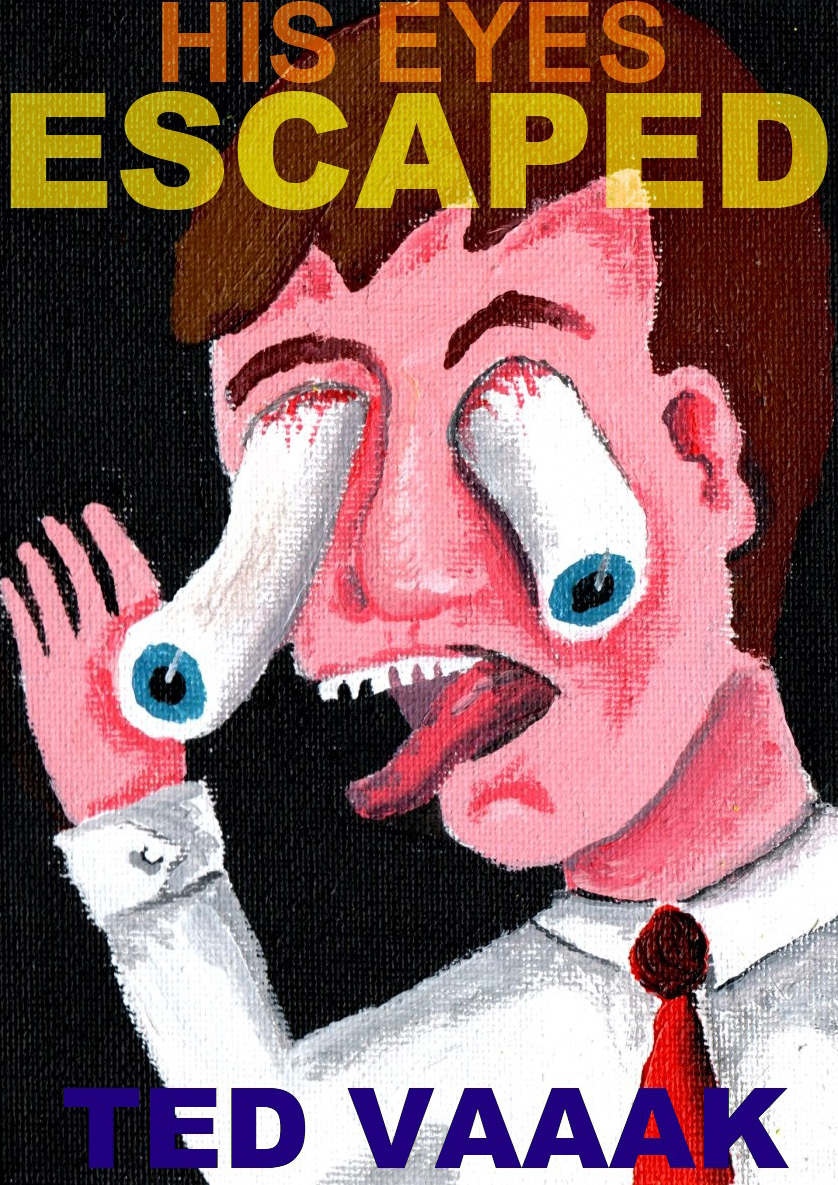
Vaaakospicy – A Vaaakospex is one who devotes himself to the art and practice of divination by the writing of science fiction, horror, and letters to the editor of the local paper complaining about the entirety of the modern world and all the people within it.
Appendix II: The Lord Mayors Of Essex
Between 1274 (when the role was inaugurated by Edward Longshanks as part of his reforms of English governance and law) and 1484 (when Richard III had Essex banished from the Kingdom in disgust – an exile it would not return from for almost a hundred years), Essex was chiefly governed by a Lord Mayor. In granting the holder powers beyond those normally entrusted to a public servant, the role created a highly turbulent atmosphere of political terror within the county, and the average life expectancy of a Lord Mayor upon taking the role was a little less than 2 years. Despite the constant turmoil, Essex flourished, and, in what is considered by many to be its greatest era, produced over seven figures of lasting historical interest during this period.
Below is a list of the Lord Mayors, their reigns, and their deaths (those that died after leaving office are marked with an asterisk).
William Clapsmith (1232-1275), Lord Mayor from 1274-1275, killed in the Battle Of Wix.
William Clapsmith II (1256-1275), Lord Mayor from 1275-1278, killed in the Battle of Wix, but his corpse was appointed Lord Mayor in the absence of any remaining Essex noblemen.
Reverend Alfred Swith (1232-1281), Lord Mayor from 1278-1281, lost in a nave.
Captain Mark Gull (1254-1283), Lord Mayor from 1281-1283, died while hunting with friends in Epping Forest, shot in the head by Gareth Manhey The Lord Mayor of Suffolk, Henry le Walleis The Lord Mayor of London, Richard Pelope The Baron of Hackney, and Barry Hulm The Vice Mayor Of Essex. Five other arrows were unclaimed.
Barry Hulm (1261-1283), Lord Mayor from 4pm on the 16th of June 1283 until 6pm on the 16th June 1283, when he was shot while returning from a hunting trip in Epping Forest by Gareth Manhey The Lord Mayor of Suffolk, Henry le Walleis The Lord Mayor of London and Richard Pelope The Baron of Hackney.
William Baldspine* (1258-1289), Lord Mayor from 1283-1285, exiled to Kent, succumbing thereafter to melancholie.
Harold Pligh (1240-1287), Lord Mayor from 1285-1287, attacked by pigs near Colchester.
Alan Well (1250-1294), Lord Mayor from 1287-1294, while tied to the crowstone at Leigh-On-Sea for the annual Bathing Of The Mayor ceremony he was, ironically, eaten to death by gulls.
Peter Pitt (1272-1299), Lord Mayor from 1294-1299, throttled to death by his wife, Mary, in an argument over his excessive use of vernacular.
George Shulvie* (1268-1342), Lord Mayor from 1299-1312, forced to become a monk, eventually dying from colic.
Simon Frintonson (1271-1313), Lord Mayor from 1312-1313, accidentally pushed from stage onto a soldier’s pike at a rally in Mayland.
Marcus Fishmarsh (1280-1316), Lord Mayor from 1313-1316, became so angry at the continued existence of Suffolk he punched himself to death in his chambers.
Peter Huglholm (1264-c.1321), Lord Mayor from 1316-1324, a recluse, it was not noticed that he had died for some time. His cause of death was given at the time as “rotting”.
Graham Bearwife (later Gail Barewife)* (1279-1338), Lord Mayor from 1324 and 1327, captured by a travelling circus and forced to tour the country as a mimsy man, dying finally from over dancing.
Ted Grark (1233-1333), Lord Mayor from 1327 and 1333, a dutchman, died by his own hand, which he had lost some years before but which eventually returned.
Peter Basselgroat (1291-1334), Lord Mayor from 1333-1334, killed in a duel.
John Froath (1256-1335), Lord Mayor from 1334-1335, having earned the nickname Lord Wormstarver after refusing to let the body of his predecessor be interred in the ground until the flesh had been fully consumed by him and his wife so they may gain, he claimed, the wisdom of his foe, he was quickly overcome by a frenzied madness, and after a mere seven months as Mayor, in which he killed an estimated twelve hundred of his subjects, he died when he fell into some brambles and ripped himself to shreds in an attempt to escape. The fate of his wife is unknown.
Alan* (1301-1339), Lord Mayor from 1335 and 1336, referred to as The Alan in many contemporary accounts, was found guilty of prudery and sentenced to seven years in an oubliette, where he froze to death.
Goodson Goodwine (1291-1342), Lord Mayor from 1336 and 1342, largely held responsible for both the beginning and the end of the Ice Madness craze which overtook Essex at this time, whereby every pit, oubliette and well was filled with ice, as it was considered more durable and less prone to poisonings than water. The ice was imported from afar and delivered to the county in a fleet of ships, the building of which necessitated a 112% tax rate to be imposed on the countyfolk, eventually leading to the Ice Riots of 1342. A crowd ” compris’d of bothe man and woeman” burned Chelmsford to the ground, smashed up most of Danbury, and eventually pulled Goodson Goodwine from the bed of his Maldon mansion, encased him in ice, and floated him out to sea, where it is assumed that he either drowned or suffocated, if he had not already succumbed to the cold.
Mary Frull (1293-1384) Lord Mayor from 1342-1384, known locally as Lovely Old Mary, she died from oldness at the age of 91 (her age is also given as 53 in some accounts).
____ _______* (____-____), Lord Mayor from 1384-1391, moved to Ipswich to be with his wife and subsequently stricken from the records.
George L’Huel (1356-1391), Lord Mayor from May 22nd and June 16th 1391, a mason, he was sacrificed in Epping Forest to commemorate the hundredth anniversary of the deaths of Lord Mayors Captain Mark Gull and Barry Hulm 108 years earlier.
Harold Wreoueaeoeul (1359-1401), Lord Mayor from 1391-1401, poisoned by a mason.
George L’Huel II (1377-1403), Lord Mayor from 1401-1403, expired while waiting for lunch at an alehouse in Bradwell.
Alice Tibbs* (1365-?), Lord Mayor from 1403-1414, a witch, she was summoned to another realm.
Kevin Pissmark (1365-1415), Lord Mayor from 1414-1415, hanged for his crimes (unrecorded).
William William (1367-1421), Lord Mayor from 1415-1421, drowned in a puddle.
William Williamson (1385-1423), Lord Mayor from 1421-1423, while laughing at a retelling of his father’s death, died by choking on an apple.
Gladford Manswell (1391-1424), Lord Mayor from 1423-1424, eaten by dogs.
John Vregh (1387-1429), Lord Mayor from 1424-1429, vanished.
Matthew Fistfoal* (1399-1467), Lord Mayor from 1429-1435, he eventually tired of his rule and ventured west, finding fame and fortune in Somerset as a bawdyteller. He is said to have died of an excess of love.
Clive Efans (1401-1439), Lord Mayor from 1435-1439, said by many to be a foreigner, he was ridiculed for much of his life, although eventually earned the respect of the Essex people. Died in the first known case of English Sweate.
Henry Daymento (1387-1443), Lord Mayor from 1439-1443, while boating off the shore of the Naze, he and his crew were attacked by fisherman who mistook his yacht for a passing French warship, killing everyone onboard.
George Porge (1403-1448), Lord Mayor from 1443-1448, found dead in the sun.
William Bresselhamingham (1412-1453), Lord Mayor from 1448-1453, was accused of Suffolkry on account of his misshapen jaw and kicked to death while holidaying in Maldon.
George Mass (1406-1454), Lord Mayor from 1453-1454, the first of seven brothers to be Lord Mayor, found dead in a ditch.
William Mass (1407-1455), Lord Mayor from 1454-1455, leapt from a church tower.
Barry Mass (1404-1456), Lord Mayor from 1455-1456, died from a curdling of blood.
Alan Mass (1409-1458), Lord Mayor from 1456-1458, fell from horse.
Peter Mass (1408-1458), Lord Mayor from May to December 1458, mutilated by a crab.
Matthew Mass (1403-1459), Lord Mayor from 1458-1459, found in an oven.
Toby Mass (1405-1483), Lord Mayor from 1459-1483, known as Toby The Unsinister, was beloved by all, and it was considered a great shame when he died peacefully in his sleep at the age of 78.
Bary Qwine (1453-1484), Lord mayor from 1483-1484, summoned to the Tower of London by Richard III and ordered to either “defende the stayt of Essex or feed thyself to the ravens upon the lawne.” Bary, an ineloquent man, and shy, fed himself to the crows at Richard’s feet. Richard, in retaliation and abject despair, declared that the county of Essex now were “lands o’er which I wud wish no longer to rule”, and had a ditch dug along its unrivered borders to separate the territory from the mainland.