“Hot, isn’t it,” said the man.
“Yes, it is,” said the woman.
The conversation was repeated for many days.
__________
Notes:
1. Written on August 1st, 2018
“Hot, isn’t it,” said the man.
“Yes, it is,” said the woman.
The conversation was repeated for many days.
__________
Notes:
1. Written on August 1st, 2018
Our recent excavations underneath this site unearthed a sealed and untouched incontamination chamber, dating from sometime before the Shift.
The following documents are transcriptions of the text contained on the printed matter found within. Visual matter beyond the scope of words is currently being checked against the corpus for possible rights issues, and will hopefully be cleared for inclusion presently. Descriptions of any relevant visual material needed to contextualise the written contents are presented for illumination purposes only, and pre-suppose no claim to their ownership.
The physical artefacts from the chamber, including food receptacles, mechanical and electrical devices, clothing, waste products, are currently being scanned for reproduction and facsimiliation, and an exhibition of these items is currently planned for the endmonths of this year.
The desiccated corpse of the inhabitant of the chamber is currently under investigation by the genetics department and will be released only when the consent of itself or any cloned derivatives are able to be obtained. As forced maturation techniques are uncertain to work on pre-shift brain matter, if undesiccation of the body is not successful the obtainment of consent will be unable to be legally accepted for at least a further 19.54 years.
Item 001: The Racist Cop in The Zoo Of The Future (#8 in a series of 183)
Printed card measuring approximately 13.4yn by 8.93333333333333333yn. Full colour printed picture on upside, text on obside. Found on floor, although analysis suggests it was likely to have been affixed to the wall (picture side visible) near desk by an adhesive of some kind.
The picture on the card depicts a clothed humanoid individual hollering aggressively directly at the [holder of the] camera.
Racist Cop
Timespan: 19th – 21st Century
Area: Prevalent everywhere except Antarctica
Diet: Meat, Fish, Bread
Characteristics: Racist Cops were a common subspecies of the parasitic Cop organisms of the early industrial/commercial periods of human history, characterised predominantly by severe and extreme violent tendencies, allied with a strong herd instinct and a subservience to a rigid social hierarchy within their own populations.
Shorn of their uniforms and weaponry, and separated from their protective power structures, however, Racist Cops are revealed to be incredibly timid and cowardly creatures, although still obnoxious, as can be seen with our specimen here in The Zoo Of The Future.
Although likely to withdraw from the view of passing crowds, if the Racist Cop sees its chance it will leap from hiding and attempt to attack or abuse any isolated figure it deems weaker than itself. For your own safety, please do not linger by the enclosure unaccompanied.
There is some scientific disagreement as to whether the Racist Cop and the Sexist Cop (#9) were distinct subspecies or just slightly different variations of the same.
The Racist Cop in The Zoo Of The Future is card #8 in a series of 183.
__________
Item 002: The Forever Parade
Encyclopaedia article printed on a single sheet of yellowed paper (32.1yn by 21.4yn approximately), text on one side only. At the bottom of the page, text indicates that this was page 1 of 3, but the other two pages were not contained within the chamber. Found on desk.
The Forever Parade
The Forever Parade is a conceptual public gathering, consisting of a continuous, oblivious, and ever-changing grouping of pedestrians that, when followed through time on mapping sites, surveillance channels and other publicly available data, constitute the titular Forever Parade. The length of existence and the minimum sizing of the group for such a grouping to be considered a Forever Parade have long been under debate, but, at a minimum, a constant presence of at least two members must always be maintained.
Although the concept of a Forever Parade was first outlined (but not named) by the Descriptionist Ichid Naer in her book “The Poetics of NoSpace” (published in 2021), it wasn’t until the introduction of live image data to Apple Street in 2029 that a real world example could be shown and followed.
As of today, the longest currently running Forever Parade is London Forever III, which has been existence for over 17 years. However, there is some discussion over the legitimacy of this, due to the tendency for it to be artificially maintained by tourists, sponsors, and other organised groups (see Controversies).
1. Conceptual Framing and Mathematical Underpinning
2. Real World Discovery And Naming
3. Records
4. Controversies
5. A list of current Forever Parades
1. Conceptual Framing and Mathematical Underpinning
In an aside in The Poetics Of NoSpace, Ichid Naer outlined a scenario thusly: “Given this density of humanity, there is, if we could only trace them, certain to be flocks of people that, viewed as a mass rather than as individuals, have been perambulating across the city together for some time now and will continue on for some time yet. It would be interesting to see whether there is any pattern to their routes, to find out whether these unknown, unaware, herds, constantly shedding and gaining new members as they roll onwards, loop back and forth between two points like the seasonal migrations of birds, or if they snake erratically through the streets at random in the fashion of a photon trying, futilely, to escape the heart of the sun.”
After much online interest and discussion of this passage, she, along with the mathematician Ogawa Naoko, attempted to set out the statistical like-
[article ends]
__________
Item 003: untitled poem
Handwritten poem, red ink on green paper (6.1yn by 6.12yn). Found screwed up on desktop.
Fractured heart
beneath shattered ribs
Crooked hands
around my throat
Is this enough
if its all there is
__________
Item 004: The Metamorphoses
Encyclopaedia article printed on sheets of yellowed paper (32.1 yn by 21.4 yn approximately), text on one side only. The article consisted of 4 sheets of paper, held together by a coiled loop of stiffened metal. Probable fifth page of article missing. Found on floor by extraction tube.
The Metamorphoses
This article is about the television show. For the viral infection, please see The_Metamorphoses(Virus) or The_Metamorphoses(2049_Outbreak). For the work by Ovid, please see Metamorphoses. For the work by Jean Michel Jarre, please see Métamorphoses.
1. Overview
2. List of Episodes
3. Controversy
4. Legacy
1. Overview
The Metamorphoses was a short-lived lifestyle and makeover television programme, created and produced by the BBC and broadcast on six consecutive Saturday nights between October and November 2037. The premise of the show was based around the contemporary fashion for transformational surgery. The programme’s unique selling point was the use of metamorphical designs created by some of the foremost visual artists of the day, as well as the lavish cost and large-scale scope of some of the resulting human-sculptures. Contestants/subjects were chosen by the producers, except in the case of Helen Shapiro, who was chosen at (longtime fan) Damien Hirst’s request.
On a per-episode basis it was one of the most expensive television shows ever produced. Due to the cost and its low viewing figures, it became a symbol of the decline of the BBC, and was specifically cited in the Jackson Report as evidence of the public service failures of the then tax-supported media network, and of the shortcomings of the public service broadcasting paradigm as a whole. For a more detailed look at the Jackson Report and its outcomes, please see Jackson_Report(BBC).
2. List of Episodes
Episode 1 – The Angel Of Hull
Broadcast Date – Saturday, October 10, 2037
Artist – Brian Froud
Subject – Fran Masereel
Fran Masereel, a primary school teacher from Hull, was given fully functioning fairy wings, granting her limited powers of “flight”.
Episode 2 – Aural Sensations
Broadcast Date – Saturday, October 17, 2037
Artist – Toby Vok
Subject – Toby Vok
The musician and artist Toby Vok finally transformed himself into his long-proposed “All Body Theremin”.
Episode 3 – For The Love Of God Again
Broadcast Date – Saturday, October 24, 2037
Artist – Damien Hirst
Subject – Helen Shapiro
In this episode Damien Hirst recreated his famous sculpture For The Love Of God by embedding over £200 million worth of diamonds into 90 year-old Helen Shapiro’s face.
Notes: During filming, Damien Hirst fell off his skateboard and broke his leg, hip and elbow.
Episode 4 – It’s What Inside That Counts
Broadcast Date – Saturday, October 31, 2037
Artist – Olajire Ojo
Subject – “Barry”
This week’s subject, appearing anonymously and pseudonymously, was a sufferer of extreme body dysmorphic disorder who had been seeking psychiatric help for his condition. In a collaboration with both his doctor and the artist, it was decided that his flesh and bone structure be removed and his internal organs placed in a series of crystal cubes connected by a complex series of osmotic membranes. The various organ cubes could be stacked in any order.
Note: This was the only episode where the basic human form was completely discarded during the metamorphosis.
Episode 5 – You Will Never See My Perfection No Matter How Long You Stare
Broadcast Date – Saturday, November 7, 2037
Artist – CHU
Subject – Desmond Tenpence
In a direct response to the previous week’s work, the renowned conceptual artist CHU took Desmond Riley, an extreme narcissist, and made him perfectly transparent by means of a cloaking device fashioned from an internal woven mesh of carbon nanotubes.
Episode 6 – The Averaged (Wo)man
Broadcast Date – Saturday, November 14, 2037
Artist – Armelle Bourgoin
Subject – Mary Rose Hannigan
Supermodel Mary Rose Hannigan, long-feted as the most beautiful woman in the world, wished to retire and live a normal life. To this end, the French artist Armelle Bourgoin gave her the “average” British face, which ended up being almost perfectly featureless.
3. Controversy
Along with public, political and press unease over the cost and quality of the programme, there was also a specific controversy concerning the use of private customer data in the sixth episode’s metamorphosis. Although it was later claimed by the artist that he had not actually accessed the licence fee payer’s database to create the “averaged face”, instead having used a simple photo-manipulation smear effect in a freely available software package, it did not prevent the corporation being levied with a record fine for data insecurity.
4. Legacy
A persistent urban legend has arisen concerning a supposed seventh episode (or possibly an alternate regular episode) in which a child’s hands were replaced by crab’s claws (some variants of the tale have them as lobster claws). However, no firm evidence of the creation of this episode or of its broadcast has ever been discovered.
__________
Item 005: Notes on reading dates, times and orders of magnitude in historical documents.
Large book. Dimensions approximately 33.3yn by 18.43yn. Cover only, all internal pages ripped out. Analysis suggests cover made of (unidentified) animal matter. Found in desk drawer.
__________
Item 006: Untitled placard
Mounted and framed placard, placed on the wall above desk. Dimensions: 35.99yn by 25.34125yn. The glass in the frame had been cracked (although not shattered), seemingly by a single blow.
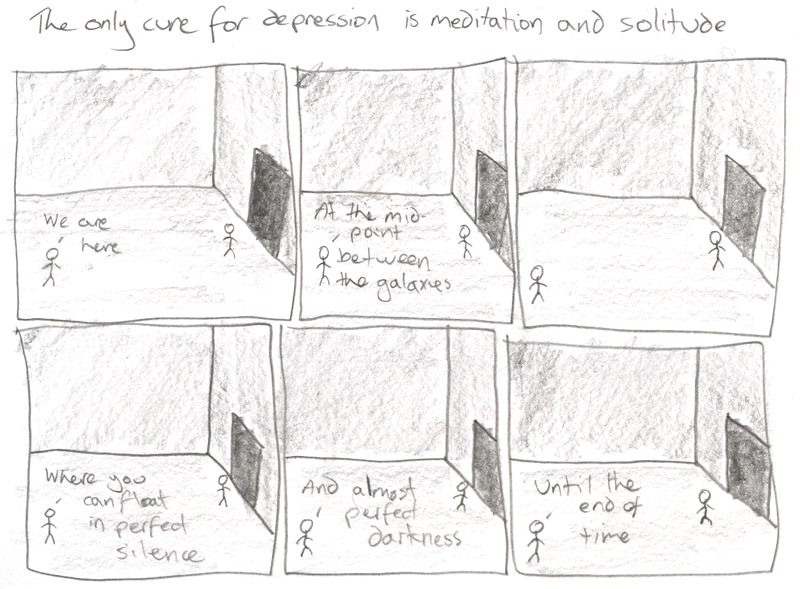
For many years I walked across the earth, so as to encounter new things and thus gain an increased knowledge of the world. But eventually I came to the belief that constant novelty hindered the pursuit of wisdom, for it allowed no room for the contemplation of events, nor of meaning.
So I returned to my home and sat down in my room, and vowed to remain there until I truly understood the few meagre things contained within – the walls, the floors, the ceilings, the bed, and myself.
After many years of solitude, the only epiphany I experienced was that, when I walked the earth, I walked because I enjoyed it. And when it was solitude that I craved, I sat here. The reasons I constructed around these decisions were delusions constructed to create a mythology of purpose around my actions that they themselves did not warrant nor deserve.
Yet there was no importance in anything I had ever done, no purpose, and there never was in anything. And in understanding this I could live and die freely, however I pleased.
__________
Item 007:
Text, scratched onto the wall near bed.
Nostalgia eases the present by erasing the past
___________
Item 008:
Text, scratched onto the wall near extraction tube.
I remember so much and so little at the same time
___________
Item 009: fragment
Scrap of paper ripped from a larger sheet, found in corpses trouser pocket. Roughly triangular in shape, 8yn in length along longest edge. Text printed on both sides.
Side 1
is, Geo
y friends li
ereas your penis
ing disgusts them, you kno
Side 2
e monstr
nd said, “Lo
f it. It’ll never fit
she nodded and said, “That’
my problem, is it. It’s your anu
__________
Notes:
1. Written in January and February 2016
2. Although I think bits of it came from the year before


__________
Notes:
1. Written on January 10th, 2008
It wasn’t very big but it was still bigger than expected. I put it on the table and listened for a while. The sound quality was excellent and the volume satisfyingly loud. However I fear it might be defective. It left filthy smudges on the tabletop, and when I searched for an off switch it bit me.
Now it’s hiding under the settee and it appears to be leaking
__________
Notes:
1. Written on September 23rd, 2016
There was a woman whose mother had died giving birth to her, and who thereafter lived alone with her father in a cottage in the woods. Although her father loved her very much, the sadness he felt for his lost wife whenever he looked at his daughter overwhelmed him, and for the rest of his life he never spoke to her without weeping.
On her 18th birthday, her father died and she was left alone. She ran outside and went into the woods and wept there under the stars.
While she wept a cat came down quietly from the branches of a tree and sat on her lap and said to her, “It breaks my heart to see someone so sad. Let me grant you a wish, so that you may know happiness.”
The woman thought of her father, weeping without his wife. And she thought of the mothers and fathers of her friends, and how much happier than her father they must have been, for she never saw them weep while talking to their children. So she said to the cat, “It must be companionship that stops one being sad. I don’t want to grow old on my own.”
The cat said, “So is that your wish, to not grow old on your own?” And the woman wiped away her tears and nodded her head. “And so it is and shall be,” said the cat, and it climbed out of her lap and was gone.
The woman felt no happier, although no sadder either. She went back to her cottage and went straight to sleep, expecting to find there beside her in her bed a husband when she awoke. But in the morning she was still on her own.
She scolded herself for believing in dreams and wishes, and resolved to find a cure for her unhappiness herself. That afternoon she went into town and chose for herself a husband. He was a sailor, and spent 11 months of every year at sea. Every January she would see him to his boat, and every December, after almost a year on her own in her cottage, she would welcome him back. And while she seemed not to age a day while he was away, he looked older by the year.
When he came to retire she appeared no older than 25, and more beautiful by far than ever, for her beauty was now complimented by her kindness and her wisdom. Yet he by now was aged and weak, his back bent, his hair grey, and his features set in a permanent scowl of discontent.
During her long years of marriage she had learned to love being alone, for it gave her the freedom to think and to dream, and to learn and grow wise. When her husband came home for good, by day she tended to his needs without complaint and with a gentleness he was not necessarily deserving of. At night, while he slept, she would step outside into the woods and take a moment for herself, for in the day she felt at times more like a servant than a wife. She could feel her life ticking away with each moment that passed in his service.
On the morning of her 70th birthday she noticed her first grey hair, and that very afternoon her husband died. For the first time in ten years she was alone. She ran outside and went into the woods and wept there under the stars. While she wept a cat came down quietly from the branches of a tree and sat on her lap and said to her, “I granted you a wish once, so that you would know happiness. It breaks my heart to see you so sad once again.”
“I am not sad, although you granted me no wish,” she said. “I am on my own again, and happy for it.”
“I granted you no wish?” said the cat. “Yet you are not old.”
“Old? Look at this grey hair and tell me I am not old.”
At that moment the sky cleared and she saw the cat clearly in the moonlight.
“Dear cat, my friend,” she said. “How is it that you are still so black, with not a grey hair anywhere upon your fine furry coat?”
“I grow not old, for I keep myself to myself, and am always on my own.”
And with that the cat climbed out of the woman’s lap and went on its way and was gone. And the woman was left on her own to ponder the wish she had been granted all those years before.
They say she is still out there somewhere in the woods, more beautiful than it is possible to describe, and although she is on her own she is not alone, for she has herself. She waits now for no-one, and shall never let you see her, no matter how long you look.
__________
Notes:
1. Written in July 2014