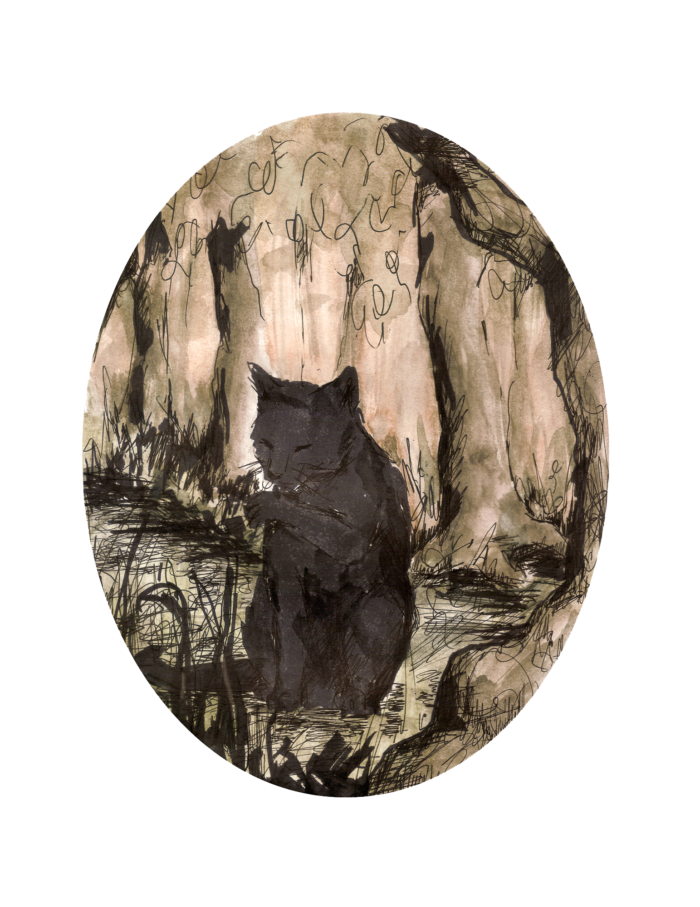
A priest was eating lunch one day in the seminary cloisters when a cat sauntered past his bench and made its way across the empty square without a care in the world. Curious as to where cats go when they travel around on their own, he decided to follow it on its perambulations. He hurried from his bench as it exited the churchyard and pursued it out into the town.
It was dusk before the priest returned. He went to bed without saying a word, and soon the priest went mad and died.
__________
Notes:
1. Written on July 15th, 2015
2. The phrase “soon the priest went mad and died” is taken from Japanese folk tale “The Emperor’s Finger”, translated by Royall Tyler, and found in the book “Japanese Tales”, which he edited and translated.
3. I’m pretty much convinced that every story ever written could be improved by using “Soon [the protagonist] went mad and died” as its final line.
If you like the things you've read here please consider subscribing to my patreon or my ko-fi. Patreon subscribers get not just early access to content and also the occasional gift, but also my eternal gratitude. Which I'm not sure is very useful, but is certainly very real.(Ko-fi contributors probably only get the gratitude I'm afraid, but please get in touch if you want more). Thank you!
Yeah, I’ve never done this before. I‘m fucking terrified. I was terrified before, for weeks, and I was terrified earlier, out the back, waiting, trying to relax. And I’m terrified now, standing here on stage behind this mike. Holding on to this lectern as tightly as I can for courage and trying not to look any of you in the eye. In case I see your disgust, your anger. Your boredom. Or possibly worse, your delight and amusement. So I’m going to concentrate as intently on my notes as I can, pick them up, and start to read.
“Yeah, I’ve never done this before,” I read out loud, word for word from the page. “So, um, sorry. If it’s, you know…” I give you an amiable shrug — at least I hope it’s amiable — and then finish my sentence… “if it’s a bit shit.”
A couple of you laugh. Not many, and not for long. The audience equivalent of a polite smile.
“So anyway,” I say, “I hope this is okay.” A slight pause before the next line. “I’ve been dreading this all week.” And I try to say that, I mean to say that, with a laugh, but at best I manage a sort of forced unnatural looking smile.
Do I tell you, I’m wondering, when I’m practicing this at home, how at first, even in an empty room, I can’t speak. That I’m so self-conscious I can’t even overcome the horror of public speaking in private, to no-one. And not just on the first day of practicing this performance, but every day. Every time.
But I decide it’s probably best not to say a word of that to you. It’d sound needy, pleading. So I go back instead to hoped-for charm of admitted first-time incompetence instead.
“This is…” I start, looking down at my script, flicking through the pages nervously before putting it back down. I start again: “Sorry, I should have said thank you all for coming. And I hope the book’s not a disappointment. Well, I hope tonight’s not a disappointment either, as you’ve all made the effort to come down here and everything. But especially the book…”
Is this silence that follows as uncomfortable for you as it is for me? Is my voice as inflectionless, as emotionless, as I always fear? Does it sound as awful to you as it always sounds to me when I hear a snippet of it on tape, in the background of some video I’ve recorded on my phone? Or in my dreams.
I read some advice somewhere about how it’s best to never, ever, think about the sound of your voice, not when you’re speaking, when you’re giving a speech, but I’ve started now and how to stop? It’s like being told at the dentist or wherever not to swallow — you’re told not to swallow and you think okay, I won’t swallow, and then, only then, do you realise how desperate you are to swallow, how you’ll choke if you don’t, and you can feel your tongue absolutely huge in your month and if you don’t swallow you’ll fucking choke you’ll choke on your own tongue you’ll forget how to breathe you’ll fucking die.
I’m trying not to think of the true sound of my own voice and yet I have to speak. I have to just close my mind to it and carry on and read.
So I go back to my notes. I read. I speak.
“This first story — it’s not the first one in the book but it’s the first one tonight — it’s called The Reading, or Performance Anxiety.”
I’ve printed these stories out quite big, so the letters are nice and distinct and the lines are all clearly separated and everything’s nice and easy to read, but now this massive font I’ve used gives all my words the appearance of a children’s story, some sort of Ladybird learn to read book. Or the eyesight test lettering in the opticians.
Actually I think they probably most closely resemble the look of a note in a film, with everything printed in big sparse letters and held in shot long enough so even the slowest readers in the audience can read them. Now I’ve seen this similarity I can’t stop seeing it, and it gives my words a weird and unwanted sense of unreality and artifice, undermining everything I’ve written.
And without belief in what you’ve written your words are nothing.
But finally now I’m on to the story, past all my introductory messages and the title and onto what you’ve come for. Onto what you’ve paid for. I discard the first page, place it neatly to the left, and find my place at the top of the second page. And finally now move onto the first story.
“The Reading, Or Performance Anxiety,” I read out, word for word from the page. “Yeah, I’ve never done this before. I’m fucking terrified.”
It all sounds so hollow, limp and dead on my tongue, disconnected from any real feeling. Not just from feeling but disconnected from each other as well, as if they weren’t even sentences, but instead a collection of unconnected words in a line, and now, as I say them, everything begins to fall apart.
“I was terrified before. For weeks. And I — sorry — I was terrified… I was terrified earlier. Out the back. Waiting. To relax. Wait — I was waiting, I was trying to relax. I…”
I turn the page and during this tiny pause someone shouts ou-
—GET ON WITH IT!
Er, yeah, thanks, like that. Exactly like that.
So I say, “Yes,” back to them. I say, “Sorry.”
But now when I look back at the page I can’t even read the words. My heart’s pounding like I’m afraid I’m about to get hit. I can feel the tears at the edges of my eyes. Not quite tears actually, not yet, but that hot feeling across my face and that… that pricking sensation you get when you can tell that they’re just about to form, when you know that you might still be able to hold them back but once they start they’ll just flow and flow.
That shout, that one single shout.
It feels like being told off at school, never wanting to admit it hurts but it hurts. Being shouted at, being mocked, bullied, abused. And the years of hardening yourself to it, hardening your face so it’s a case of studied blankness even though inside you’re in fucking turmoil.
Please let me still have that control.
“I’m. I’m…” I stammer. “And I’m terrified now, standing here on this stage — ”
— WELL GET THE FUCK OFF IT THEN!
You all laugh. I can hear it and I can see it and you don’t even stop even though I’m looking at you, pleading with you with my eyes, my face, my slumped shoulders, to just
not
laugh
— YOU’RE FUCKING SHIT AT THIS YOU KNOW!
“I’m sorry you think that,” is my, well, my rather lame reply. I’m defeated and I know it, but I try to hold it off, if only for a second. “Sorry, the lights — I can’t see anything — who am I talking to here?”
— EVERYONE!
You laugh and you laugh. The whole room full of you laughing, at him, at his words. And at me, and mine.
“Can you just… Look, can’t you just let me finish. Look, I’m sorry, sorry everyone, maybe it’ll be better if I start again.”
I turn the page back.
“The Reading,” I repeat. “Or, Performance Anxiety.”
I see him getting up, the heckler, out of the corner of my eye. Hopefully he’s leaving and we can all get on with this.
Get through this.
“Yeah, I’ve never done this before. I’m fucking terrified. I was terrified before, for weeks, and I was terrified earlier — ”
— Give that here.
A hand – that hand, there, this hand, his hand – reaches over the lectern and grabs at my papers.
— I bet I can do this better than you anyway. I could hardly be worse, could I?
He laughs. You all laugh.
I look up. There’s a spotlight — that one there — that’s shining directly into my eyes and I can only see this person, this heckler, this intruder, I can only see him as a shadow. The audience, I can’t see the audience anymore, I can’t see them at all. It’s only you now, whoever you are, you. A silhouette, a suggestion — you’re everyone and no-one, you’re looming aggression and dominance and contempt and
I shove him out of the way, two-handed in the chest and he stumbles backwards and, in his surprise, trips. People behind me cheer and I take his place on the stage, turn my back on him and turn round to the room and look at all of you here in the audience. I can see the relief on your faces. The anticipation, the strange vicarious joy.
I begin to flick through the pages of his story, discarding them one by one, passing through the words you’ve already heard and the things you’ve already seen, until on the fourth page I find my place, find the here and now.
I begin to read.
“He sits there at the back of the stage for a moment, too dazed to stand, and listens to me speak. I read his words, shout them out confidently as if they were my own. And I speak them with a clarity, with a conviction, that he could never match. As if the words are mine, now. As if they have always been mine, always will be mine.
“He can’t bear to watch, can’t bear to watch me, my performance, my… usurpation, and he crawls behind the curtains, gets up and stumbles his way down the passages to try and escape. To get away. Away from the stage. Away from all of us. Away from his embarrassment. His failures.
“He opens the fire escape and there’s a sudden rush of silence as the freezing cold air hits his face and he imagines me stopping, triumphant, as I reach the end of his story. He pictures me bowing slightly, taking his applause, the pages of his words littering the stage around my feet. I step around the podium and I hold my arms wide and I bow again and smile and wave and your ovation grows and grows and then finally begins to subside.
“And now his tears flow.”
__________
Notes:
1. Written on March 19, 2016
2. This was performed at a liars league event in London on November 8th, 2016.
3. Where it was performed by the wonderful Peter Kenny, as can be seen below:
If you like the things you've read here please consider subscribing to my patreon or my ko-fi. Patreon subscribers get not just early access to content and also the occasional gift, but also my eternal gratitude. Which I'm not sure is very useful, but is certainly very real.(Ko-fi contributors probably only get the gratitude I'm afraid, but please get in touch if you want more). Thank you!
A nobleman had three sons, but had yet to choose an heir. When a cat began to attack the people of the town, he said to his children, “Whosoever saves our town from this beast of the woods shall inherit my castle and all of my lands”, and each in turn set out to defeat the creature.
The eldest son, a soldier, picked up his sword and marched out into the forest where the cat was presumed to live. He quickly became lost and as the day headed towards night he sat down and, although only intending to rest for a short while, fell asleep against the trunk of an old oak tree.
When he awoke it was completely dark, and he could feel the weight of something heavy on his chest. He tried to move but the cat – for that was what it was – pushed its claws into his skin, opened its eyes (which were just in front of his own) and said, “What is that you hold in your hand? Is it for me?”
The eldest son said, “Yes, it is for you. If you let me up I will give you a good close look of it.”
The cat leapt from his chest and sat down in front of him, and the soldier stood up, raised his sword, and swung it as hard and as fast as he could at where the cat now sat. But the cat’s eyes saw so well in the dark that she dodged easily out of the way of the blade and then leapt forward and sliced the man’s head clean off his shoulders with a single swipe of her claws.
The next day the nobleman woke to find the head of his eldest son left on their front doorstep. So now the middle son, a farmer, strode out into the woods to try his luck against the cat, and he carried with him a bag of the finest meat from his farm.
He quickly became lost as he searched through the unfamiliar woods, and as the day headed towards night he sat down to quickly rest his weary legs. Yet he ended up falling into a deep sleep, and when he awoke the moon was high in the night sky above him and bathed in its light he could see the cat asleep on his own chest.
When he tried to move, the cat awoke and said, “What is that you have in your bag? Is it for me?”
And the farmer said, “Yes, it is for you. If you let me up I’ll open up my bag and give you a good look at what’s inside.”
The cat leapt from his chest and sat down in front of him, and the farmer stood up and opened his sack, and took from within the meat he had brought with him and threw it onto the ground. The cat sniffed at it, and satisfied that it was not poisoned, began greedily to eat, and while she was distracted the farmer held out the sack and approached the cat as quietly as he could. But before he could lower the sack over her head, she heard the heavy beat of his heart as he approached and leapt out of his way. And then, with a single swipe of her claws, sliced his head clean from his shoulders just as she had his brother’s.
The next morning, the nobleman awoke to find the head of his second son left on their back doorstep. The youngest son, who was considered useless by his father for he had no job nor a wife, was still in bed when his father burst into his room. His father dragged him from his room and insisted that now he must make his way to the forest and avenge the deaths of his brothers.
To this the young son said, “I do not want to, father. This cat has never harmed me. And anyway, surely now you’ve sent my brothers to their deaths, I’m your only son and your only heir.”
In response to this insolence the nobleman beat his son so fiercely that the boy agreed tearfully to go to the forest, even if only to escape his father’s wrath, and he set out before lunch. In the woods, the young man did not become lost, for he cared not where he was, and gave no thought to returning home.
He came soon to a stream, where he stripped naked and bathed his battered body in the babbling brook. When he returned to the riverbank, he found the cat sat on top of his blood-soaked clothes, busily tearing the cloth of his shirt to ribbons with her long and deadly claws.
She looked up at him while her claws continued their game and said, “Your first brother brought me a sword, and with it tried to kill me. Your second brother brought me a sack of food, and with it tried to capture me. What have you brought me, and what will you try to do to me with it?”
The youngest son said, “I have brought you nothing, for I came here only to escape my father. I cannot give you my clothes, for you have already destroyed them. I cannot give you money, for I have no job and therefore nothing to spend. I cannot give you food, for I forgot to bring any even for myself. All I have left are my hands and my heart, which for all my trying I have never been able to give away, for no-one has ever wanted to employ me, and nor have any ever wanted to love me.”
“Then give me your hands,” said the cat. “To stroke me whenever I desire. And give me your heart, to love me forever and without regret, and in return I shall become your wife, and cease my attacks upon on the town.”
So they returned to his home and were married that very afternoon. For saving the town, the young man and his cat wife inherited the nobleman’s castle and all of his lands, and lived there benevolently until the end of their days. As for where the noblemen went, none would say.
__________
Notes:
1. The earliest version of this I can find is from August 2013.
2. Illustrated again by Holly English
3. I like cats
If you like the things you've read here please consider subscribing to my patreon or my ko-fi. Patreon subscribers get not just early access to content and also the occasional gift, but also my eternal gratitude. Which I'm not sure is very useful, but is certainly very real.(Ko-fi contributors probably only get the gratitude I'm afraid, but please get in touch if you want more). Thank you!
Your girlfriend asked you once if you’d help her out with her training over the park one evening, because her usual training partner was away somewhere, or ill or injured, maybe, you can’t really remember.
Anyway she asked you if you’d help her train – it wouldn’t involve much, she stressed, just standing around mostly – and you’d said yes, and you went to the park and she did her drills for the best part of an hour, which involved sprinting away from you to the fence and back, and then her punching away at your raised hands for a minute or so, you holding them up unsteadily, your hands absurdly huge in the sparring gloves she’d given you to wear, this short routine repeated, turn, sprint, turn, sprint, punch, punch, punch, until she could barely stand and your hands were numb from the contact.
As she got her breath back at the end, towelled her face, gulped down her water, you took the gloves off and threw them down with her gear and said, “Man, christ, my wrists really ache now,” and she said, “Your wrists ache? You just stood there,” and you laughed and said, “Yeah, I know,” and laughed again and she laughed too. And then while she was getting changed, sitting down, leant up against a tree, she looked over to where you were standing and said, “You didn’t have to come if you didn’t want to, you know,” and you said, no, you wanted to, it was good, you enjoyed yourself, it was fun, it was a lovely evening.
And it was great and you did enjoy it, but she didn’t ask you to come next week when she went and she never asked you again and a few months later you weren’t even together anymore and these days to be honest you’re surprised you ever were.
But you find yourself thinking about it sometimes, remembering that night over the park, the hazy summer dusklight, your bags of clothes by the trunk of the tree, the cars passing by on the road just behind the fence, windows down, music strobing as they passed.
And her face in front of yours, the intensity of her stare, the joy and the pain as she pushed herself harder and harder, the rage of her fists against your padded palms, the thud of glove on glove, the jolt of every blow in your wrists, in your shoulders, trying to hold yourself there, trying to stand firm.
She turns, sprints away. Turns, sprints back.
__________
Notes:
1. Written in January 23rd, 2016
2. This was going to be published in a book this year, but in the end it wasn’t published in a book this year
3. So here it is instead
If you like the things you've read here please consider subscribing to my patreon or my ko-fi. Patreon subscribers get not just early access to content and also the occasional gift, but also my eternal gratitude. Which I'm not sure is very useful, but is certainly very real.(Ko-fi contributors probably only get the gratitude I'm afraid, but please get in touch if you want more). Thank you!
There was an old lady who gave birth to twins. Knowing that she would not live long enough to see them grow up, she did what she could to help them succeed without her.
The first child she called Wun. She cut out Wun’s eyes and replaced them with her own, so that Wun would not have to see anything for the very first time, but would instead recognise everything that life put in his way.
The second child she called Mun. She cut off Mun’s ears and replaced them with her own, so that Mun would not hear anything that he could not understand, for her ears had already heard everything that had ever been said.
Then, unexpectedly, she gave birth to a third child. Before she could give any gifts to her daughter, or even a name, the old lady died, and the child was left to fend for herself.
The two brothers called their sister Undun, and they tried to raise her as best they could, for despite their young age they were already as wise as their dear dead mother. But Undun knew nothing, and although they tried to impress upon her their wisdom she would not learn what they wished, and they often found her ignorance exasperating.
One day, while out foraging for food in the forest, the three of them came across a lake as clear and as deep as the sky. Wun, upon seeing the stillness of the lake, and Mun, on hearing the sound of a stone dropped into its waters, knew how deep the lake must be, and how dangerous.
But Undun, having no fear and unaware of the danger, ran straight into the lake. Wun and Mun rolled their eyes in despair and disgust at Undun’s recklessness, but she laughed and laughed and laughed, for she found the act of swimming in the sun-warmed waters immensely pleasurable, and could not understand at all why her brothers would not join her.
Later that afternoon, the three of them were walking once more through the forest when they came upon a wandering minstrel, who was playing a merry song of his own devising. Wun, on seeing the minstrel’s face, and Mun, on hearing the seditious lyrics in his song, knew he was a disreputable sort, and they both hurried past as quickly as they could.
But Undun, having never seen other men before except for her two brothers, nor having heard any music save the birds’ sweet songs, just danced and danced and danced, for she found the music incredibly joyous and the man’s singing unendingly delightful, and could not understand why her brothers would not join her.
Eventually, the minstrel went on his way, and Undun followed after her two brothers, who had gone on ahead even deeper into the forest, and she found them there deep in conversation with a man upon a horse. Wun, who could see the finery of his clothes, and Mun, who could hear the refined tone of his voice, knew that the man must be a prince of great import, and if not a prince than perhaps even a king.
But Undun, ignorant of the distinctions and importances of class, was unimpressed by his status, and when he, after praising her beauty as the greatest he had ever seen, asked for her hand in marriage, Undun run away in fear, wondering why he wanted to mutilate her and take a piece of her as his own.
The prince (for he was not yet a king) was outraged by this behaviour, and despite Wun and Mun’s apologies, his fury would not subside. The prince ordered them to help his men search the forest for her, and although they looked in every place they thought she could be, they could not find her. After many days of fruitless searching, the prince, heartbroken and disgusted, ordered the execution of Wun and Mun, and that very night they hanged. The prince and his men returned to the kingdom from whence they had came, and were never seen again within the walls of the woods.
Undun, who did not know the sorts of places she should be, had spent the days playing in bears’ caves, sleeping in crows’ nests, and talking happily to strangers. There in the forest she lived until the very end of its days, when the trees withered away and all the world had changed, by which time she knew more about the joys of life than any other who had lived.
But that still was not enough for Undun, and where she went from there I could not say. Yet I know that she was happy, and happier still with every passing day.
__________
Notes:
1. Written in February 2014, and never much changed since
If you like the things you've read here please consider subscribing to my patreon or my ko-fi. Patreon subscribers get not just early access to content and also the occasional gift, but also my eternal gratitude. Which I'm not sure is very useful, but is certainly very real.(Ko-fi contributors probably only get the gratitude I'm afraid, but please get in touch if you want more). Thank you!