The Hole

I was digging a hole. I was about five. I’d gotten bored of digging a hole in the sandpit, and wanted more of a challenge.

After I had been digging for a while, my mother came out of the house to see what I was doing or at least to make sure I hadn’t drowned in the pond.

“What are you doing?” she said, even though she could see what I was doing.

“I’m digging,” I said, making a digging motion with my spade in the air and then following it up with a digging motion in the earth that wasn’t so much a digging motion as actual digging, so that she could see that I was digging and that I could see that she could see that I was digging.

“I can see that,” she said, which she could.

I did another little dig and she didn’t like it and said, “Can you stop that?!”

I looked up at her. She was about twenty feet away at the lip of the shaft I’d dug and she looked quite small up there, and because of the way she was silhouetted against the sky I couldn’t even really make out her face and certainly not the ferocity of her scowl.

Disobeying a tiny faceless mother who was twenty feet or more away was easier than disobeying a huge red-faced mother who was right next to you with her hand poised in the air to administer some sort of smack. So I pretended I couldn’t hear her and carried on digging and hoped soon I’d be deep enough that I really couldn’t hear her and therefore I wouldn’t be doing anything bad like pretending I couldn’t hear her when I could.

It turns out that, due to the acoustics of tunnels and shafts and wells and, presumably, all the other possible types of tubes, I would always be able to hear her. And I always have.

I’m 39 years old now and she’s as loud as ever, even though I’m seven miles down and can no longer see the sky, let alone her faceless face peering down at me, shouting out admonishments into the hole that I dug in her beautiful garden, never letting me forget that I’ve ruined her lawn forever.

She probably wishes I really had drowned in the fish pond by now.

__________

Notes:

1. Written on September 25th, 2017
2. This is at least the third story on here called “The Hole”
3. And probably the worst

Eye, Ear, Key, Archway

1. Eye

There was an eyeball in the door where the lock should be, twitching around frantically, lidless and tearful, fearful, too, presumably, overcome with anxiety anticipating the inevitable moment soon when someone would approach and push the key in their hand through the eye’s exposed pupil and into the nerve clusters behind.

I didn’t have a key. I was uninvited. I knocked, but there was no answer. The eye looked up at me while I knocked and then down again when I looked at it looking at me.

I bent down then and pushed my own eye up to the door eye and let it stare into me. I’m not sure why. It just felt like the right thing to do. It was probably lonely, I thought. And shy. Staring directly into the eyes of a shy person is the best way to put them at ease so doing the same to the eye of a shy door would also be the best way to put the door at ease. Maybe it wouldn’t feel so vulnerable and alone if it knew we all had eyes, that it wasn’t alone in the world, that there was more eyes out there, more than it could ever meet, ever imagine.

Of course, that was what it wanted. That was how the disease spread. It wasn’t long before my body had begun to door, before the frantic search of an opening in which to wedge myself consumed every moment of thought.

The gap beneath the stairs where I stored my shoes looked promising, ripe for annexing. I manoeuvred myself into position, settled down and waited for my doorification to reach completion, for the cupboarding of the understair space to conclude.

___

2. Ear

There was an ear in the door where the lock should be. It didn’t twitch or move or weep or do anything at all really, just went on being very clearly a human ear where the lock should be. I had my key in my hand but couldn’t bring myself to push it into the earhole. What if the human ear was connected to a human brain? What would it sound like, I thought, if someone forced a key into your ear, as the cold metal scraped its way down the ear canal, then the slow twist of of it, metal turning bone, until, with a click, the mechanism was sprung and your face swung slowly opened, the cogs inside revealed to the world, rusted, worn down, barely turning at all.

So I waited around, pretending to talk on my phone, until someone came out from inside and then quickly nipped in before the door closed behind them.

___

3. Key

There was a lock in the door exactly where the lock should be, just like you’d expect. But instead of a key I had hundreds of tiny little fingers and toes hanging from my keyring and I had to try each of them in turn until I found the right finger or toe for the lock. It’s horrible, but that’s how keys are made so what can you do about it, really?

I mean, it’s okay for you out there in your fancy cities with your state of the art eye scanners and ear whisperators and the like, but out here in the marshes we’ve got to make do with more durable methods that can cope with the mould and the cold and the harsh salt air.

I felt like that too when i first moved out here but I’m sort of used to it now.

I made some sort of skeleton key joke at work last week when I had to lock up at the end of the day but nobody laughed and a couple of people cried. I’ve probably got a couple of their toes in my pocket, I thought, a little callously, but at least I didn’t say it out loud. I’m not a monster.

___

4. Archway

There wasn’t a door and there wasn’t a lock and there wasn’t even any keys or anything, anywhere. They were illegal. And blasphemous, or was it heretical, I can never remember which is which. Maybe they were both.

In places where privacy was expected, like toilets, and changing rooms, and weeping chambers, a convoluted series of walls and archways at right angles to each other in varying patterns of complexity were employed, through which you’d have to twist and turn your way through before you reached whichever isolated sanctum resided within and beyond.

Lines of sight from one room to another were thus impossible. It was a very civilised system, and the envy of most other states.

The archways were made of rib bones. The walls from flayed skin. To keep the flies out, human hair hung down from the archways. Each hair was threaded carefully through the many discarded teeth of children, and the rattling these made as you parted them with your hands was strangely delightful in a way I could never adequately explain.

__________

Notes:

1. Written on September 27th, 2017
2. While I was in the park in Colchester, I think
3. Not that that really matters to anyone I expect
blood

There was blood in the garden
thick across the stepping stones
and paving slabs
echoes of a fight here last night
or the aftermath of one elsewhere

between
what?
cats
and foxes
cats
and birds
cats
and cats

or a hedgehog perhaps
dragged out of the dead leaves
beneath the bamboo
carved open
by tooth
and claw
and carried away
from this fenced-in prison
to someone else’s lair

__________

Notes:

1. Written on September 15th, 2017

The Boy Who Had Too Much Blood

Simon was a young boy, much like any other. The sort of child so bland and ineffectual, so devoid of inspiration or spirit, you can hardly even see that they’re there. If he had not suffered from a rare affliction it is doubtful even his parents would have remembered his name.

For you see, Simon simply had too much blood. If it wasn’t flowing from his nose it was weeping from his gums. If it wasn’t dripping from his fingers it was seeping through his shoes. But his body would not stop, and it kept producing more and more whether it was needed or not.

The doctors tried to help him. They covered him in bandages one time, but they quickly became absolutely sodden and useless, and he had to be washed clean in the garden, his father hosing him down while the neighbours curiously peered over the fence.

Next the doctors tried covering him completely in wax, leaving no hole or cut uncoated. They held him by the ankles and dipped him head first into a huge bubbling vat of the stuff and at first it appeared to work, until they noticed Simon’s face slowly expanding and everyone had to frantically scrape the wax away before he burst like a birthday balloon.

After that it was thought best to try a treatment of leeches, but they gorged themselves too quickly and exploded with a sound like gunshots. And so eventually the doctors tired of Simon and they let him go home.

His parents covered the carpets in plastic, moved his bedroom to the cellar, and let him drip where he pleased.

It was on the third night that they found him drowned in his bed. And yet his blood continued to flow even though he no longer lived.

His mother began to cry. Poor Simon, she thought. But her husband was made of sterner and, ironically I suppose, in light of poor Simon’s condition, more heartless stuff.

“Stop your crying, my dear,” he said. “This could turn out to be the best thing that has ever happened to us.” He wiped away her tears and leant in close and whispered his plan into her ears.

Two weeks later they opened up a shop, the finest sausage house in the whole of the county. Their signature dish was their Black Pudding, and people came from miles and miles around just to try it.

“Come in, come in,” Simon’s father would say to the hordes gathering at the doors. “And try the finest family-made food you will ever taste.”


__________

Notes:

1. Written on August 31st, 2006
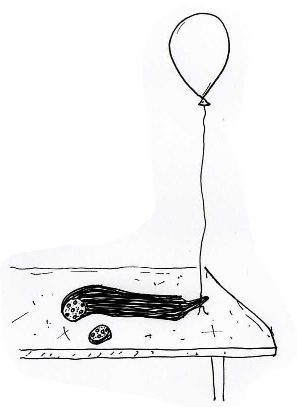
2. And illustrated by Hugh Paterson
3. Around about the same time

The Fish In The Pond

__________

Notes:

1. Written on November 29th, 2012
2. And inspired I expect by the David Hockney illustration The Boy Hidden In A Fish
3. Which I’d seen in a gallery some time
4. And which can be found in the book Six Fairy Tales From The Brothers Grimm, illustrated by David Hockney and translated by Heiner Bastian
5. And which I couldn’t stop thinking about
6. After I’d seen it
7. For months on end